Tunisia, the tiny brave nation the sparked the Arab uprisings, relies heavily on tourism. But the revolution, subsequent instability and a months-long civil war in next-door Libya convinced many tourists to look elsewhere.
The national climate has gotten a lot better in the last several months after the historic free and fair October elections. Protests, riots, and strikes are a near daily occurrence but now in a normalized manner befitting a democracy as opposed to a general state of insecurity.
One of the reasons for the revolutionary upheaval was the state of the economy, especially high youth unemployment. Creating a thriving economy remains a laborious task and unemployment has actually risen since the revolutions as businesses have shut doors and tourism taking a fall.
You can do YOUR part but checking out this beautiful country.
That is why I was quite pleased to see the New York Times travel section do a very nice piece on Tunisia this past week:
BELOW the watchtower of the ancient fortress known as the Ribat, a panoramic view of the Tunisian city of Sousse unfolds. To the east lies the Mediterranean coast, where the Carthaginians moored their navy during epic battles with the Roman Empire. To the south and west, the labyrinthine passageways of the medina, the city’s old walled quarter, extend to the vanishing point amid a sea of tightly packed houses and minarets.....
For those further intrigued, a few years back the Times did an even better piece - less a blow-by-blow travel account and more a poignant memoir on Tunisia - that featured one of my favorite places in the country:
The crowd that gathers at El Firma, a 1920’s colonial farmhouse-turned-restaurant on a desolate stretch of land outside Tunis, is as sexy and stylish as any in the world. The work of two young Tunisian brothers, Sadri and Iyed Tej — one trained in Nice, the other at the legendary Institut Paul Bocuse in Lyon — and a Tunisian designer, Mona Mechri, El Firma is an incredibly beautiful place: antique cushioned chairs reupholstered in fuschia and furs play off the rough, warm texture of old stone walls; in the long, narrow dining room, a large plate-glass window frames a tumult of vegetation outside, lighted from below. On a soft night recently, when the seating moved out into the large, open courtyard, I found young Tunisian fashionistas just home from Paris or Rome sitting on sofas backed by elaborate antique headboards while their mothers (even more stylish) remained at tables deep in conversation in a jumble of languages. Above it all, a canopy of sheer curtains billowed sensuously in the soothing breezes of the North African night....
Last week, the Kevorkian Center was honored to host Brazilian anthropologist Paulo Pinto, Director of the Center for Middle East Studies at Universidade Federal Fluminense.
Paulo had done extensive fieldwork among Sufis in Syria and has now undertaken a study of Muslims in Brazil. With regards to the latter, the key questions he presents are: what is Islam in Brazil? how is Islam produced in Brazil?
While this short blog will not recap all his insights, I would like to focus on a few that really struck me.
Pinto rightly emphasis taking into account local dynamics alongside national and transnational orders in the way of making Brazilian Muslim identity.
There is a parallel history of Islam in Brazil. A colonial heritage of African slaves that disappears in with end of slave trade due to cut off with African and assimilation to Catholic or African Brazilian religions.
And the contemporary Muslim presence of Middle Eastern immigrants (mostly Syrians, Lebanese, and Palestinians). But this presence is based on a search for a community in the name of ethnic identity. Muslim immigrants articulate identity as Syrian, for instance, due to a Brazilian immigrate narrative viewing Arabs as undesirable non-Europeans and Islam as less than favorable.
Between the 1920s-1960s, Brazil witnessed the creation of Muslim charitable societies that ensure social welfare but also places of sociability to maintain Muslim identity.
The 1960s-1990s witnessed the first mosque (mainly due to funding from Gulf countries and Iran). But Islam is understood as a cultural heritage within larger set of religious norms. Until the 1990s Islam is understood by Muslims in Brazil (or at least institutions) as a Middle Eastern cultural heritage and not a missionary religion. The first conversions start in 1990s and spark fierce debate: Should we accept them? How do we integrate people who do not know Arabic or cultural norms?
Some preachers argue, for instance, that Brazilian society is not conducive to Muslim life. In 1995, Maria Morara, an engineer from a Catholic university, converts to Islam after traveling to Egypt and Turkey. But a many preachers reject her and she starts a debate with the preachers arguing that Brazil is indeed compatible: traditional, religious, and very family oriented; and Evangelical Churches are not much different from Islam and manage convert millions, and Islam could do the same only if it took seriously the task of tackling Brazilian religiosity. During this era, some communities begin to open up for converts. And in 1997 Rio-based institutions stop being heritage-oriented and begin to see Islam as a universal message for all and accept conversion of Brazilians without Arab or Muslim background. By 2010, half of Brazilian Muslim community is already converts and the figure is 85% in Rio.
But this is not without internal tension between Brazilians of Arab heritage and simply Brazilians (everybody without Middle East background). For instance, a Brazilian Arab Christian who converts to Islam is considered Arab but any other isn't. So ethnic and heritage-bound identity remains very important. Arab Brazilians righteously argue they have an imbibed (one surmises) Muslim culture and do not need to learn it while converts challenge/retort that they know the actual purpose of Islamic norms and practices as opposed to Arabs who simply reproduce their heritage. A binary between tradition vs. acquired religion.
Among converts many identify with Salafi (conservative Islam), a codification of Islam as a way-of-life learned and followed, and more than the sacred texts. Very pedagogical. But born-and-raised Muslims do not see any attraction to Salafism. Instead Islam in often an expressed (occasionally Sufi) cultural tradition (Sufi traditions in Brazil are just traditions removed from pious sentiments. Ex. muwlid (Prophet's birthday), a Sufi holiday opposed by Salafis as antithetical to orthodox Islam). When these traditions and rituals are performed in mosques, such as muwaild, this is where religious differences between born-and-raised Arab Brazilians and converts rise to the fore as the latter exit the mosque in opposition to the intermixing of culture and Islam.
But converts do not deny religious value of some culture aspects, such as Arabic where Islam isn't localized but complement to religiosity. Or living in a Muslim society: Syria, Lebanon, Saudi Arabia, India, South Africa, and Pakistan are popular destinations.
In a related tangent, each Muslim community in Brazilian (meaning regionally) produces a different codification of Islam and Muslim identity because local dynamics connection differently to national and transnational processes. Ex. Rio is different from the tribal area near Paraguay, Brazil and Argentina.
This is the Islam I was brought up in and the one I practice now, and the only Islam I recognize: We live Islam as we live it. And that is the source of our unassailable faith. This is our connection to Allah.
And it is the Islam of 99% of Muslims, Brazil included.
As a corollary, here's an interesting video on the rise of Islam in the favelas of Brazil:
NYU Abu Dhabi @ NYC (at the refurbished townhouse on 19 Washington Square North) recently held an event presenting the architectural design for the United Arab Emirates' new parliamentary building, the Federal National Council (FNC).
Steven Ehrlich at Ehrlich Architects (Los Angeles), a former peace corps volunteer in Morocco and Nigeria, is the man behind the project. He titles his architectural philosophy"multicultural modernism".
Ehrlich, as his resume suggests, is no vapid man chasing a high-profile project and putting a nice label on it. His philosophy is grounded in the world outside America's borders that he witnessed as a young man. Take his time in Morocco ('69-'72), there he made note of the common gathering space in the center of markets - a living room on the scale of an entire city - and the casting of shadows and movements of lights that characterize the suk in Marrakech. And I have to stay that his observation seemed so evident and yet it was if something that stood in front of me for so long needed to be pointed out. I have been to the suk in Tunis and elsewhere numerous times, and there is an almost natural way in which shade is built into the structure:
Marrakech, Morocco.
Fez, Morocco.
Then there is the dichotomy between asymmetry in housing (more organic and responsive to the environment) and the use of symmetry for important monuments, particularly mosques, in Arabic-Islamic landscapes.
Notice the contrast between the asymmetrical homes and the symmetry reserved for the Grand Mosque of Kairoun (Tunisia), for instance:
Ehrlich also spent time in the Sahara and West Africa. His observations here would also later influence his work: buildings that grew out of the ground and harmonious with their environment, it is these structures that are most sustainable for their builders do not have modern tools. Again the marketplace serves as a courtyard of the city and shade extant even in the public streets.
Dogan (?) tribe in West Africa, for instance, have found there is no need to create new form as they replicate the square bottom and round top for both baskets and homes with different symbolism: rain falls, the grain raises. Again, living in delicate harmony with their environment. The lesson: indigenous architecture leads to a sustainable future. Best to learn from the fathers.
The challenge for Ehrlich and his team then in designing their ideal building (and let me state here that this rather small L.A. shop won a 14-firm competition that included much better known heavy weights Zaha Hadid, Norman Foster, and others) was to combine local and global. To quote Ehrlich, How to make something ancient and contemporary and culturally rooted and part of a global dialogue?
How can you be simultaneously global and local? An example of how not do to this would be the glass-rimmed towers in some Middle Eastern architecture meant to convey "modernity" but such structures are incongruent with the local environment. Ehrlich argues for embracing the indigenous styles (for instance, Islamic tradition of geometry) and local ethnography and cultural elements. Everything looking the same would be a great tragedy.
Their winning entry (the new Federal National Council Parliament Building Complex will be 1million sq feet along the cornice facing north and flanked by two buildings) will seek to create a symmetrical building.
The main meeting room is the central building - a dome structure acts a shade rather than enclosing the space. And notice that the pattern design is the sun's gift rather than been craved in stone (akin to the shade pattern in the above suk). There is a strong tradition of pattern in Islamic design - and in this case the pattern will come from sun and shade and always change from time of year and day:
The dome structure evolved from the national flower (tribulus omanense) from five to a ten point connection.
The assembly hall is the imploded structural pattern of the dome into wood-clad beams inside the chamber. There is controlled natural light - majlis (seating area) above with frosted glass center. Notice how the geometry is the architecture instead of the typical Western attempts of having a box with geometry over it.
In my question to Ehrlich I wondered if this new building will be part of the urban fabric of Abu Dhabi and the UAE. The late Anthony Shadid (how poorer are we without him?!) wrote about the new building projects in Doha - all quite impressive akin to the above - meant to situate the Qatari city as a global capital, but these projects are not seen as reflective of the social milieu among the local populace. Existing more as elite motifs projecting the elites' aspirations for global recognition within the Persian Gulf's new architectural competition for iconic structures (launched by Dubai's glitzy building speer) rather than having meaning at home. Ehrlich took my question and rephrased as such: will Emirates recognize (in the imagination) the FNC akin to the way Americans see the U.S. Capital? He thinks they will, especially since the structure not only includes elected (and this requires a caveat I will explain later) representatives, but also public space: gallery and a library, for one. Time will tell.
P.S. As for the political elements, I will save that for a follow-up post.
Over at MERIP Rikke Hostrup Haugbolle and Francesco Cavatorta have an amusing theory as to why the moderate Islamist al Nahda did so well in the Tunisian October 2011 election - the first free and fair contest in the nation's history. The usual explanations do not hold up since other parties can claim similar variables:
First, it is said that Ennahda was very quick and skilled in reorganizing its structures across the country after Ben Ali fell on January 14, 2011.
A second explanation refers to the party’s reputation as an uncompromising opposition movement during the Ben Ali era.
A third focuses on the weaknesses of the other parties.
Fourth, some attribute the appeal of Ennahda to its constant quest for a democratic national “consensus” on the key institutional matters.
Finally, the party is said to have swayed many voters with pledges of job creation and replication of the successful Turkish model of economic development.
But all of these can be said about other Tunisian parties in one variant or another. So why did al Nahda do so well? Because the preceding decade has witnessed a rejuvenation in piety among Tunisians. But not the Political Islam menacingly portrayed in Western media. Rather a new generation of pious Tunisians who are seeking an individualized Islam - one that is based on freedom to practice faith as opposed to a political project to enforce a selective interpretation of Islam.
Tunisia in the decade leading to the January 2011 revolution witnessed the emergence of a civic Islam: Islamic private schools, Qur'anic classes and community social welfare organizations. In part, this was a reaction to the Ben 'Ali regime which publicly demoted Islam while emphasizing neo-liberal consumerism increasingly tainted with regime graft. By partaking in an Islamic civic activity - "performative activity" to borrow anthropological discourse - Tunisians were subtly engaging in an act of resistance against an authoritarian regime that promoted a particular life style which suited official corruption.
It is this cohort, the authors argue, that not only serves as the basis for the Nahda victory but has influenced the party to adopt an understanding of the role of Islam in public divergent from the maximalist, dogmatic and theocratic trope favored by ultra-conservatives:
The glue of these [Islamic] networks is a specific understanding and practice of Islam whereby religious precepts apply to those who choose them and are not imposed on the whole of the community. This shift in perspective has filtered up to the Ennahda leadership, which has repeated professions of tolerance incessantly since being legalized, partly to reassure secular Tunisians, but partly to reflect the views and practices of its new members and supporters. As Tirad Labbane of Riadh Ennasr said: “Our commitment to Islam does not mean that we want to impose what we do on others. In that sense, you could say that we are anti-salafi, because we do not approve of imposing behavior. If you want to wear a mini-skirt, it is not my problem; if you do not want to wear the veil, it is also not my problem. Choices have to be left to individuals; the state cannot impose behavior. From the state authorities we ask only that they let us do our work in peace.”
Their rallying to Ennahda is not necessarily based on the party’s policy statements or past record or on Ghannouchi’s leadership, but on the assumption that it is the political actor whose beliefs are closest to their own.
These Tunisians are skeptical of any drive for a strong state. Young and old, the pious middle class rather supports the quest for a decentralized democracy with a thriving private sector. The new generation believes in free-market forces and wants to take advantage of the fall of the regime to expand the business opportunities they were denied under Ben Ali. The older generation has weathered the repression of the strong, centralized state and wishes to break it up. Their other bond is the attachment to religious values and practices that they believe should inform policymaking, but not dictate it.
Recently, al Nahda announced that it will not include Islamic law as a source of legislation in a new constitution to be drafted. I wrote a piece on that here.
I hope that authors are right. That al Nahda and the new pious character of many Tunisians is one enlightened with a belief in individual choice and liberty. If Tunisians can navigate this period in their history and establish an Arab Muslim democracy at home both with Islamic identity and individual liberty then they'll be trailblazers for the region once again.
I have noticed that this blog does not feature enough Middle Eastern art, and that's of course my fault. So here's an effort to make amends (source: designboom):
exploring the gestures and movements of calligraphy, nantes-based artist kaalam (aka julien breton) has created a body of work that uses hand-held light and long-exposure photographic techniques tocapture the transient form within a real setting. often utilizing urban or historical sites as histhree-dimensional canvas, the self-taught artist creates his own latin-based alphabet that heavily draws from traditional arabic and eastern calligraphy. arresting and provocative, the floating light forms are not mere superimposed subjects but display a direct engagement with the surroundings. the capturing process, which can take as long as ten minutes, requires a choreographed movement which kaalam practices before hand in heavy repetition. different colours of 'ink' is achieved through pigmented gelatin which is applied directly onto the lamps. none of the photographs are retouchedor edited, illustrating the laborious process in a single shot.
On Tuesday, March 20, thousands of Tunisians marched in opposition to extremist voices calling for an Islamic state or a Caliphate. Tunisia's revolutionary uprising in January 2011 did not feature any evident exhibition of religious imagery or oratory, but Salafi (literally predecessors - those who aspire to live a conservative Muslim life ostensibly reflective of the life the Muslim predecessors lived in the age of the Prophet) voices have sought to claim the revolution as a mandate to impose Shari'a; or, rather, their puritanical interpretation of Islamic law.
Since the 1956 independence from France, Tunisia has been the most avidly secular Arab nation. President Habib Bourguiba (1956-86) curtailed the power of the clergy, banned polygamy and gave women equal divorce rights; and promoted an ideology of state secularism so gallant that he once drank orange juice during the fasting month of Ramadan.
Many Tunisians now worry that this legacy is being threatened. The current elected government is a "troika" consisting of a moderate Islamist party (al Nahda) alongside two left-of-center secular parties (CPR and Ettakatol). While al Nahda - which holds the most ministries and the premiership - has insisted that it does not aspire to ban alcohol or bikinis, that it will keep the nation tourism-friendly, and that Islamic laws are not an aspiration, many Tunisians protest that it has trended softly in response to often violent and disruptive behavior by Salafis. Detractors argue that either Nahda is playing a cynical electoral gambit wary of alienating part of its base or that at heart it shares the Salafi goals but prefers to allow them to carry the burden.
al Nahda argues that it isn't sympathetic to either the extremists or the secularists, but is trying to negotiate a delicate middle path and is also constrained by how much attention it can focus against Salafis considering much of the country is witnessing recurrent strikes and other pressing priorities - especially over unemployment. It isn't true that al Nahda has ignored Salafis. It sent in riot police when Salafis took over a university demanding that niqab (full-face veil) students be allowed to attend. The Salafis were kicked out and the university reopened with the niqab ban still enforced. A young Salafi who head-butted a secular lawyer was arrested and, last year, Salafis who attacked a cinema screening a anti-religious film were also arrested. Salafi violence has not gone without response. Although many Tunisians, myself included, have demanded a more forceful reply.
But where should this reply come from? The ruling coalition or civil society? The Tuesday rally was staged in response to a Salafi rally. Just as a past secular and liberal gathering was in response to the head-butting incident. Tunisian editorial pages, news programs and radio shows are at the forefront in speaking against extremism - as is the average Tunisian, secular and pious. Extremism cannot be defeated with the heavy hand of the state which may only exacerbate tensions and even imperil the freedoms of the general public in the name of "combating extremism".
As the Tunisian president Moncef Marzouki recently said, “The nation cannot be built with one color. Tunisia will pay a heavy price in blood and tears if [the state] has to confront by force extremists from all sides.”
The Salafis are a obnoxious bunch. But while loud they number a marginal few. They have to rely on dramatic episodes and thuggery in their attempts to get their way. If this crosses the line into physical attacks or holding institutions hostage then that is, of course, a policing matter for the state.
But it is up to Tunisian civil society to defeat extremism and bring many of the astray youth who fell for a vacuous ideology promising a false salvation from humiliation and depravation back into the mainstream fold and discredit the Salafi current. In calling for the state to defend Tunisia's liberal legacy, these very Tunisians are themselves doing it.
The revolution did not rely on a vanguard. So why start now?
A Tunisian court on Thursday fined a newspaper publisher $665 for printing a photograph of a soccer player posing with his nude girlfriend, a ruling that raised concerns about a possible media crackdown by the country’s new Islamist government. The newspaper, Attounissia, a tabloid created after the revolution that ousted President Zine al-Abdine Ben Ali last year, published the photograph last month of Sami Khedira, a player for Real Madrid who is Tunisian and German, dressed in a tuxedo with his hands covering the breasts of his naked girlfriend, Lena Gercke, who is a German model. The publisher, Nasreddine Ben Saida, was fined for offending public morals and taste, the official TAP news agency reported.
The AP's judgement that this whole spectacle is cause for concern for press freedoms in Tunisia is made more forceful by Elliot Abrams, the in-house Middle East putative specialist at the Council on Foreign Relations:
Ghannouchi's finessing of the issue of press freedom — attack the company, not the journalists — is clever, for corporate fines will never attract the international attention and protests that arise when a journalist is jailed. But both methods can be effective in censoring Tunisia's newly free press, so Ghannouchi's failure to support freedom of expression is alarming. Ennahda dominates the new Tunisian government and parliament, so it will be difficult for liberal groups to defend press freedom if the ruling party will not do so.
For the record, the above referenced Rashid Ghannoushi does not play an official role in Tunisia's governing coalition and is no longer even the official held of the dominant party - although he remains influential within and without the party.
Both the AP and Abrams may be overdoing it. Newspapers and broadcasters should be allowed to published whatever they wish free from state censorship. But state regulation in the name of "decency" is transnational, contingent, and may not be an authoritarian portent.
Let us recall the public outcry over a mili-second of "indecency" at the Superbowl a few years back. That led to a heavier hand at the FCC imposing millions of fines for violations of "decency" and forcing networks to rewrite scripts and adopt 5-minute delays on live programs, and leading to the radio departure of "shock jock" Howard Stern.
The U.S. is not alone. Western European nations, for instance, impose restrictions and fines on language or imagery that recall the Nazis.
The obvious point being that Tunisia, the pioneer in the so-called "Arab Spring", is not a trailblazer when it comes to imposing fines in the name of upholding public morals (albeit in Tunisia's case the fine is trivial as opposed to literally millions in the FCC's handbook). Many nations have limits on free publication and broadcast. Ideally, freedom of the press would be unqualified but in practice societies negotiate boundaries. Thus these restrictions are contingent on public moods liable to change. A few years after the Super-uproar died down the FCC loosened its grip and networks once again are "pushing the boundaries".
These boundaries do not mean a state is necessarily illiberal or it is liable to return to a dictatorship. Of course, if jail time is added to the mix that, then, elevates the concern. But that isn't the case in Tunisia. And neither is the fine meant to cripple the newspaper.
Democracy-in-practice is an interminable process of contested public space and constructed notions of acceptable and unacceptable public speech and imagery. American history (the era of "I Love Lucy" to whatever contemporary awfulness) is a testament to how parameters shift and individuals in a relatively free space are able to remold their societies, contest public space and expand horizons within the context of relative freedom.
My point isn't that Tunisia acted right. As stated, I am for plenary right to publish whatever. But I am making the case that this right isn't established even in the self-styled leaders of the free world and is not a necessary condition for the maintenance of a mostly free society. And that Tunisia's democratic future is similarly not in jeopardy.
Why expect Arab democracy to look any different from the messy reality in the West?
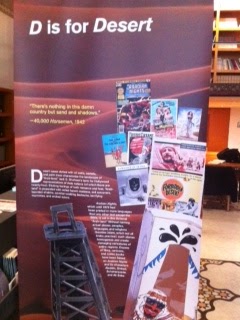
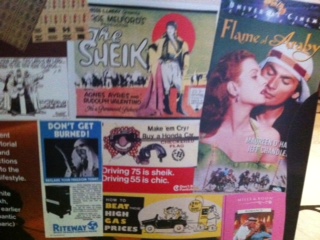
For those who missed the "A Is For Arab" display, here are some photos I took this morning before the exhibition was taken down.
The Richard Ettinghausen Library at KEVO also screened the 1943 film Adventure in Iraq:
The film was shown parallel to the exhibit as a live reflection of anti-Arab depictions in mainstream American culture, especially in Hollywood - the most powerful of mediums.
The film certainly excels toward that end: Three Americans crashland their plane in the desert between Syria and Iraq and are welcomed by a perfidious sheikh. The sheikh is refined - the bejeweled, ostentatious Arab; he naturally harbors a harem but still maintains a flirting eye for the irresistible Western woman - but openly denigrates his people ("my people are primitive"); who are not even Muslims but devil worshippers who mouth a gibberish feigning as Arabic. The only Arab women are veiled and nearly ghost-like in their ephemeral motions, along with informing the American women that "the man has many wives".
The Americans are eager to leave (one of them inquiries how far they are from "civilization"), but the Sheikh is a Nazi collaborator eager to bargain them off to Hitler! Our courageous and civilized Americans plan their escape and naturally outsmart their capturers [Spoiler Alert!] until they're cornered in the desert, brought back to the palace and in the end saved by an army battalion that receives their coded message. The American officer stares down the Sheikh: the United States does not negotiate with gangsters (this line has been lifted into the contemporary "the U.S. does not negotiate with terrorists") and the cowardly Sheikh obliges. The Americans are free. Classic happy ending. The End.
Arab Nazi collaborators, devil worshippers, the cliched invisible harem hands...it sounds awful. And the depictions are, of course, crude Orientalist fantasies. But I really enjoyed the film as - and purely as - a work of art. It is offensive to Arabs, but such a high-class offense. I am, of course, being tongue-and-cheek. But compare Adventure in Iraq to, say, the exceptionally vulgar and imbecile True Lies and other recent Hollywood anti-Arab fare and you'll understand my affinity for the former. If Arabs are to be made to watch films that portray them as lascivious savages, then, please, let the dialogue and acting appeal to our finer taste and old Hollywood lore.
The Angry Arab News Service, the blog page of Middle East academic As'ad Abu Khalil, is known for its wry humor and indiscriminate aim against any and all reactionaries.
For that reason, Abu Khalil is no fan of the self-styled leaders of the Syrian opposition - Syrian National Council and its armed affiliate the Free Syrian Army, accusing both of being fronts for the conservative Muslim Brotherhood and the latter of including ultra-conservative Salafis.
Let there be no confusion: Abu Khalil is as adamant an opponent of the Syrian regime along with every Arab regime (and every Lebanese faction). He simultaneously calls for the downfall of the Syrian regime while criticizing the conservative and reaction groups he accuses of hijacking a sincere uprising (the latter have been able to present themselves as the revolutionary vanguard in great part due to the Syrian regime's widespread arrest of liberal and leftist dissidents).
For a supporter of the Syrian people, Abu Khalil often expresses his frustration that accurately tracking developments in Syria is increasingly harder as both the regime the "Ikhwan opposition" engage, according to him, in mendacious propaganda.
The Syrian regime, of course, has every motive to smear the opposition and deny the destruction and casualties of its unceasing assault. But political oppositions also have an incentive to be histrionic, to dissemble, and to cover their own illegalities. Abu Khalil is not about setting a parallel between the Syrian regime and the opposition, but to state that facts and facts and they should be reported free from charged agendas.
It is a doctored image of a rally in Homs where the opposition flag is, of course, mutated into the Israeliflag in keeping with regime discourse that the indigenous uprising is a plot by external enemies to undermine Syria.
Here at the Kevorkian Center there is a lot of criticism of the mainstream press' coverage and portrayal of the Middle East. A lot of journalists come under scrutiny for their inability to master the language of the people they seek to profile. Nuance, depth and basic knowledge are often lacking.
Anthony Shadid, a gifted foreign correspondent whose graceful dispatches for The New York Times, The Washington Post, The Boston Globe and The Associated Press covered nearly two decades of Middle East conflict and turmoil, died, apparently of an asthma attack, on Thursday while on a reporting assignment in Syria. Tyler Hicks, a Times photographer who was with Mr. Shadid, carried his body across the border to Turkey.
For a while, the charisma and popularity of bygone leaders like Gamal Abdel Nasser in Egypt and Abdel-Karim Qassem in Iraq might have masked the states’ failures. Though harsh and oppressive, they are still viewed with nostalgia in their countries, not least because their successors seem so timid and lackluster. The moment back then was headier, too, buoyed by post-colonial optimism. Whatever else can be said about Habib Bourguiba of Tunisia, it is hard to imagine an Arab leader ostentatiously drinking orange juice on television during the month of Ramadan, when Muslims fast from dawn to dusk. “A modern nation cannot afford to stop for a month every year,” he declared. Right or wrong, the gesture was dramatic, though it earned him plenty of enemies.Today’s notion of drama is the man who overthrew him, Mr. Ben Ali, offering this concession to angry protesters: He would not serve as president for life. The protesters were not satisfied.The states have failed to foster pluralism and a universal sense of citizenship. Miserable governance fosters narrower identities as Sunnis, Shiites, Christians and so on. Lebanon’s illness — rigid identities that breed parochial chauvinisms — is becoming less and less the exception.More tangibly, the many educated young remain frustrated. They might have the basics a state provides, but no future, that bygone notion that tomorrow will be better than yesterday. That is Tunisia, in a potential glimpse ahead.
Shadid was the recipient of two Pulitzer Prizes:
In the 2004 citation, the Pulitzer Board praised “his extraordinary ability to capture, at personal peril, the voices and emotions of Iraqis as their country was invaded, their leader toppled and their way of life upended.” In the 2010 citation, the board praised “his rich, beautifully written series on Iraq as the United States departs and its people and leaders struggle to deal with the legacy of war and to shape the nation’s future.”
In a nation paradoxically highly invested but greatly uninformed about the Middle East, Shadid stood for an invaluable service in aspiring to educate his compatriots.
At KEVO we were honored to host him in Fall 2010 for a discussion on the region. We will soon put online segments from that event, unfortunately under such sad circumstances.
German-Tunisian footballer (soccer player) Sami Khedira is kind of a big deal back home. Not only does he play for the German National team, which placed third at the '06 World Cup and second at the '08 Euro Cup, but he's also on the pitch for Real Madrid - second only to FC Barcelona. And Tunisia's football obsessed. So it is natural that he would be profiled by a newspaper. Attounissia ran a story on Khedira accompanied with a photo of Khedira and his German supermodel wife from a GQ cover:
That was enough to land the publisher, editor in chief and foreign affairs editor in jail after the so-called prosecutor of the republic ordered their detention on grounds of violating public morals, according to the AP. An investigation is pending.
In the meantime, the paper is fighting back. In the last several hours it has published two editorials decrying the prosecution as a "shocking precedent" threatening censorship of the press and in another detailing the support the paper has received from the National Union of Journalists (which called for “the immediate release of all journalists and the rejection of intimidation against reporters.”), the Association of Culture and Technology, and the International Federation of Journalists, along with stating that the battleground of the "Revolution Is Back". (Both links in Arabic).
For many Tunisians it is an omission sign about the intentions of the moderate Islamist-led government and speaks to larger fears over the minor but vocal Salafite movement that has threatened and even physically attacked liberal artists and broadcasters (the paper received a bomb threat likely emanating from this circle and is being guarded by police). Many fear that the ruling party, al Nahda, will clamp down on similar papers that cross the party's definition of public morality.
Many have taken to Facebook - where more than a fifth of the nation congregates - to condemn the arrest as a throwback to the ancien regime. The page "For a free, moderate and tolerant Tunisia" even made a mock cover with obvious inference:
The most popular radio station, MosaiqueFM, (known for its liberal line), attacked the government for acting so quickly against journalists in the name of a photo while still not prosecuting those responsible for killing over 200 Tunisian civilians during the December 2010-January 2011 uprising that toppled ex-president Ben Ali.
All this raises questions as to where public moral boundaries will be drawn in the future. Few, if any, nations allow unfettered freedom - at least on public airways. America's FCC imposes prohibited fines that compel broadcasters - TV and radio - to follow guidelines on "indecency" without strictly engaging in censorship. And remember the outcry over the Janet Jackson Super Bowl haft time show that introduced the 5-minute delay and self-censorship by the networks, and exiled Howard Stern to satelliet radio?
Of course, there is a line between fines and actual detention and prosecution. Tunisia's freedom of the press is not under threat (yet, anyhow). Public morals are a common theme in Western democracies (A 1949 French law, for instances, bans the favorable portray of cowardice in children's books). Tunisia's parameters of public printing and broadcasting will likely entail a long struggle involving courts and parliamentary debate, and occasional loosening and tightening of permissible imagery and discourse.
Furthermore, it is a healthy sign that civil society and the paper have responded so forcefully in defending their rights. Such a robust counter-attack augurs well for securing freedom of expression. And legal rights are upheld so prosecution, if it goes forward, is likely to be fair and not arbitrary.
In all, a snapshot as an Arab nation continues to define the boundaries of its nascent democracy.
Tunisian interior minister Ali Larayed announced Monday the break up of a "terrorist organization" with alleged links to al Qaeda in Libya and perhaps Algeria. The 12 men arrested had previously been jailed by the ancien regime but after Tunisia's uprising and the exile of former President Ben Ali, the interim government hastily released all political prisoners, which included radical fundamentalists. An additional 9 members escaped arrest and are believed to be in Libya.
As to their motive: "They were intending to establish an Islamist state," Larayed said.
Larayed's statement merits reflection, if only for its ironic nature. Tunisia's elected government - a first in national history - is led by the moderate Islamist Hizb al Nahda (Party of the Renaissance), which won a plurality of 37% of the vote and leads a troika coalition with two secular, center-left parties. al Nahda had been banned under the previous regime. Much of its leadership, including Larayed, were jailed or forced into exile.
The Ben Ali regime portrayed al Nahda as a threat to secular values and rather indistinguishable from militant Islamic movements, such as al Qaeda. This was a domestic and foreign ploy: Only Ben Ali stood between Tunisia and harsh Islamic theocracy. It was such a common line that many secularist Tunisians internalized the discourse and at times casually defended the regime as the best option in a bad lot.
Today's news is a press release rebuffing that old line: An Islamist government fighting radicals seeking to establish an Islamic state, a goal previously (and often still) attributed to al Nahda which has been portrayed as the natural allies of the very latter now being arrested by the former. Whatever one may think of al Nahda, today's news illustrates once again just how unfounded the propagated fear of the "Muslim Brotherhood" wrecking havoc, and thus justifying secular dictatorship, has been all along. And how broad the spectrum of contemporary Islamists movements is.