Welcome to Kalamna, the student blog of the Hagop Kevorkian Center for Near Eastern Studies at NYU.
Showing posts with label Saudi Arabia. Show all posts

Wednesday, April 25, 2012

Pascal Menoret and Toby Jones On Saudi Arabia and Bahrain


Reuters. 

Recently at KEVO our very own (kind of - borrowed from NYU Abu Dhabi) Pascal Menoret and Toby Jones (Rutgers) spoke about Saudi Arabia and Bahrain in the wake of regional upheaval. 

Pascal opened up with two dates: February 24, 2011 and March 11, 2011. The former marking King Abdallah's return to the kingdom after a months long convalescence and the latter a "Day of Rage" modeled after the Egyptian gathering that culminated in the toppling of Hosni Mubarak. Thousands, if not tens of thousands, lined the streets of Jiddah to welcome the king while very few turned out for the protest. Saudi dissidents joked that the "Day of Rage" became a "Day of Police Demonstrations" as security forced constituted the only large presence. But the al Saud were not worried, notwithstanding the security precaution, and even allowed for journalists to parade the streets as a demonstration of official rhetoric: Saudi subjects are too well-cared for by their royal masters. 

20% of Saudis, according to official state figures, live on $3 and 5% live on $1. Literally, millions of improvised people in a nation resting on top of 25% of proven oil reserves. Social services in Saudi Arabia (ex. education and medical) rank low in quality. The Saudi people are clearly not well-cared for, but why does the system hold? Why the confidence of the al Saud?

Pascal outlined several reasons. The royals' ability to co-opt segments of the population, fermenting divisions between Sunnis and Shi'a, a promotion of a brand of Saudi nationalism and exceptionalism, an information blackout and the politicization of data (especially on demographics), censorship, sexual repression, and - what may be the crucial aspect of domination - the political economy of debt termed by Menoret as "the political economy of subjection". Saudis nations have accumulated heavy burdens of debt (60,000 are on a "bad debt list" and may be treated harshly, including jail) and through debt are financing their own subjection. 

Beyond that there is also the imbibed fear of repression that is recognized through the widespread prosecution of Saudis - intense and random - that has created a society were 1 in 600 Saudis are held in jail. Heavy repression and, in addition, difficulties in unifying are the challenges of Saudi dissidents and reformers.

Needless to say, a bleak picture. 

Jones spoke about Bahrain. Describing the nation as now effectively an apartheid state headed by an increasingly ruthless authoritarian (Sunni) monarchy systematically oppressing and repressing the Shi'a majority. Bahrain's regime, aided by Saudi and UAE troops, crushed a peaceful, pro-democracy movement back in 2011, but the protests continue along with their corollary of confrontations with the armed coercive state apparatus. For a background on Bahrain this Economist article is useful. 

Jones outlined a worsening reality where hopes for a compromise breakthrough are increasingly distant as the opposition has been radicalized through the bloody attempts at crackdown (the self-styled moderate vanguard has lost control and the "street" increasingly will settle for nothing less than the overthrow and exile of the royals as opposed to the erstwhile goal of constitutional monarchy) and the regime is now directed by hardliners unwilling to devise any plan of accommodation and committed to plenary obviation of the protest movement. These two polarized forces threaten to bequeath a bloody Sunni-Shi'a stalemate (akin to occupied Iraq) and regional intervention in Bahrain where Saudi, Iran, the United States and likely other nations contest the regional map on the landscape of Bahrain (akin to civil war, and arguably present, Lebanon). 

I would add (and I'm reasonably certain that Jones would agree): This is not to draw symmetry between a genuine democratic movement and an authoritarian system. The latter imposes a structure of violence that is the sparking force, conditions any reactive violent and is responsible for the entire scene of violence and its consequences.

The regime's sole basis of support has been the (mostly) Sunni middle class, but this class - Jones argues - is growing frustrated. The regime promised a crackdown would restore the order and stabilize the nation. But it is clear that political turmoil continues, especially in the villages outside of the capital Manama. Tourism, a crucial sector, has collapsed; the merchant class is shifting funds overseas, and many of the foreign banks (Bahrain's claim to fame is being a hub of mostly Islamic finance) and financial houses have relocated. Despite the regime's PR staging of a Formula One race in order to feign a turn to normality, the nation remains on precarious grounds. That remaining leg of support, akin to Syria's business class in Damascus and Aleppo, will only be aggrieved further as protests and confrontations continue and is vulnerable for the regime. 

Is there a way out for Bahrain based on liberal democracy? Jones is skeptical. The past conduct and present comportment of the regime does not augur well. 

The unifying force in Bahrain and Saudi Arabia, Jones concluded, is the political economy that the House of Saud must enforce - domestic and foreign - in the Gulf in order to maintain the royals' authoritarian rule: a regional, pro-Saudi balance and the economy of scarcity in the oil industry. 

An incredibly informative event, though sad, very sad. 

Jones' book, "Desert Kingdom" (Harvard University Press), is incredibly good and highly recommended. 

Pascal's book, "The Saudi Enigma", is on my summer's reading list but knowing Pascal I'm certain it is excellent. Pascal has a forthcoming book from Cambridge University Press, "Thugs and Zealots", on Saudi youth. 

Saturday, April 21, 2012

"Here We Have A Grand Prix To Enjoy"

Bahrain's dear and beloved foreign minister has a message for all those obnoxious journalists and human rights activists: Go bother someone else! 


Just a bit of background, after the Tunisian revolution and Egyptian overthrow of Hosni Mubarak the people of Bahrain joined their Arab compatriots in marching and rallying for democracy and representative government in their own country (a margin called for the outright abolishment of the carpet-bagging monarchy). Bahrain is effectively an apartheid state where a Sunni monarch favors the Sunni minority and disenfranchises the Shi'a majority; not only in parliamentary vote allocation (in the confined, to be generous, form of democratic-like governance allowed by the royals) but in state benefits and entitlements as well. This isn't a rigid form of apartheid akin to South Africa, but there is no denying that Shi'a are discriminated against based purely on the fact that they are Shi'a. 


Because of the sectarian schisms in the nation (a product of policy rather than history) the peaceful marches took on a sectarian character. They were never wholly Shi'a, but Sunni presence was less than forthcoming - Shi'a had a stronger claim to protest while many Sunnis feared a majoritarian government after growing accustomed to the benefits of minoritarian rule Whether the regime was willing to accommodate calls for a more robust parliament and fair distribution of votes and services is now speculation as the neighboring House of Saud sent in tanks across the Saudi Arabia-Bahrain causeway and ended the large-scale public displays of protest, although dissent and protest do continue in smaller, sporadic form (the al Saud have been aligned against any democratic movement in the Arab world, fearing precedents for their own highly repressive reign, and when they haven't been able to send tanks have sought to throw oil money in order to sabotage). And because of the sectarian split, the protests have been erroneously portrayed as pernicious doings of Shi'a Iran parlaying the Bahraini Shi'a as a fifth column to strike the Sunni Arab world. Okay then. 


For symbolic purposes, the regime even demolished the Pearl Roundabout which served as a meeting place akin to Cairo's Tahrir Square. The tanks have since left and Bahrain's government allowed for a human rights delegation as part of an effort to 'mend the wounds' and 'move on'. Really, they mean well. That delegation found evidence of not only heavy-handed police and military tactics, violent suppression of peaceful protests, arbitrary arrest and detention without charge, harassment of doctors treating the wounded, but also cases of official tortue which in many instances led to death. Over 20 Bahrains were killed during the initial phase of suppression and others have died since then (in a nation of 500,000 citizens). 


As for the Obama administration? Obama has since praised the Tunisian and Egyptian uprisings, but in Bahrain - where the US maintains the Navy's Fifth Fleet - the administration has adopted the following stance: "Victoria Nuland, the State Department spokeswoman, reiterated the administration’s position that it condemns all forms of violence. “These are unproductive, unhelpful acts in building the kind of meaningful trust and reconciliation that is needed in Bahrain, and we’re calling for...demonstrators’ restraint in ensuring that they are peaceful"


The administration's coy behavior and complete disregard for the structure of violence inflicted by the regime against an unarmed civilian population (feigning as if regime violence and demonstrators with rocks are equal) is quite reminiscent of when Hillary Clinton, hedging her bets, said that the US is not "taking sides" between the Tunisian people and the now-defunct Ben 'Ali regime. Courageously, Obama called for free election in Tunisia...after Ben 'Ali's plane departed. 


In its PR campaign to whitewash a bloody suppression aided by one of the most oppressive regimes, the authoritarian royals of Bahrain have won back their staging rights to host a Formula One race: "Bahrain's government has spent $40 million to host the global luxury sporting event, hoping to demonstrate that normal life has returned to the Gulf island kingdom after it cracked down harshly on Arab Spring demonstrations last year.  But vivid televised images of streets ablaze - as masked youths hurl petrol bombs and police fire teargas and birdshot - threaten to embarrass Formula One and the global brands that lavish it with sponsorship.  "The government are using the Formula One race to serve their PR campaign," said rights activist Nabeel Rajab. "It's not turning out the way they wanted."


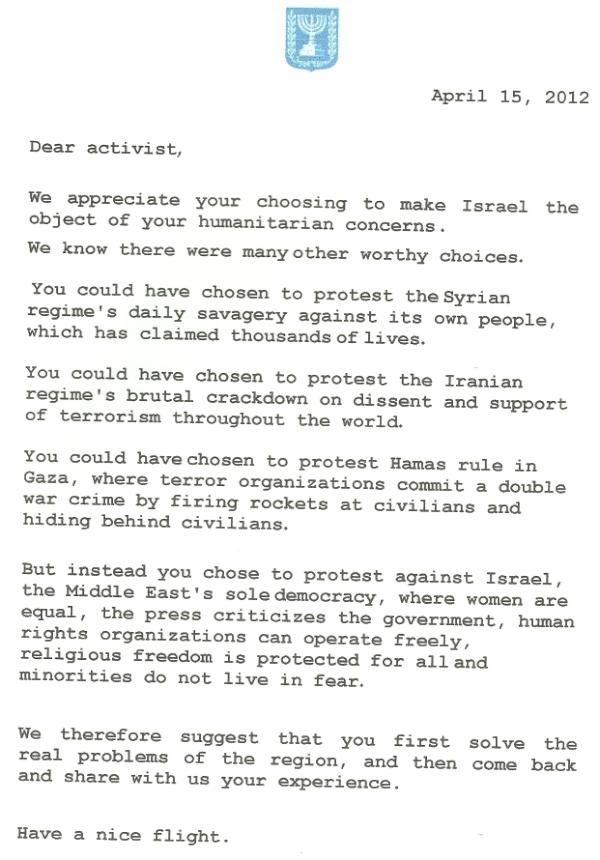
And Bahrain's Minister of Foreign (Subservience) Relations does not want to hear it anymore:  
"If any here to cover ugly bloody confrontations ,go to syria. Here we have a grand Prix to enjoy. Also, there is an ongoing war n the Sudan"

That was his Tweet. It's really cute. And made more so by borrowing the tactics of the Israeli government: 


Of course, this is a transparent tactic of obfuscation - by their standards the Syrian regime and Sudan, likewise, can point to...Bahrain and Israel. If you can't protest them all, why bother? 


But, then, why wouldn't Bahrain turn to Israel's model? It seems to have worked well enough for Israel.

The Israelis would take offense if the al Khalifa didn't. 

Friday, March 2, 2012

Rumors of a Saudi Pipeline


As'ad Abu Khalil may have been the first English-writer to report the news, via dissident sources, that a pipeline in Saudi Arabia may have been attacked ("fire in the oil pipeline between awamiyyah and safwa," Abu Khalil wrote). 


The news, relayed out of the Kingdom through Arabic channels, quickly sent oil prices to a nine-month high in after-hours trading, a jump of nearly 2% to $110.55 a barrel. The Saudi authorities quickly denied any reports of an explosion and prices depreciated. 


But it remains an illustrative event nonetheless. Many Americans are under the false impression, consistently related in popular culture and mass corporate media, that the United States is "dependent on Mideast oil." In actuality, the U.S. buys little Saudi oil (roughly 10% of American imports are from the Gulf). The crude of al Hasa (the eastern oil-producing province) does not serve American consumption, but, rather, Saudi Arabia's vital role is as a swing producer. As Timothy Mitchell explains: 
Saudi Arabia has a low domestic demand for oil and can afford to keep much of its production capacity switched off. This unused capacity (more than 3 million barrels per day in the 1990s) was close to or exceeded the total production of any other country except Russia and the United States. The excess gave Saudi Arabia the unique ability to operate as a “swing”  producer, switching its surplus on and off to discipline other producers who tried to exceed their production quotas, thus maintaining the system of scarcity.
This system of scarcity is supposed to, in theory, maintain price stability (and economic stability). For instance, Saudi Arabia recently supplemented its exports during the Libyan Civil War when the latter's oil supple was cut off. 


The Kingdom thus acts akin to Archimedes lever:  "Give me a place where I can stand--and I shall move the world." For good or ill. 

Monday, February 27, 2012

Exceptionality Between the U.S. and Saudi Arabia


Robert Vitalis' America's Kingdom is easily the best book I've read this semester. There is a lot to unravel in this American story set in Saudi Arabia - to paraphrase Vitalis. But I'll concentrate on one aspect: the rhetoric of exceptionalism.

At a Jadaliyya conference in earlier 2011, KEVO's Prof. Zach Lockman reminded the academic audience students do not enter the classroom with empty slates. They have been bombarded on the supposed sedimented past, present and very essentialist nature of the Middle East, Arabs and Islam. For Lockman, the first task is disarming students by "thinking about intersections we can exploit usefully" between the region and"students' own lives" in America in order "to critically locate [students] in the same social time and space." 

In a strong sense, Vitalis' America's Kingdom exemplifies Lockman's purposive instruction by going after the dual exceptionalism that categories American self-reflection, on one hand, and domestic discourse about the Mideast being uniquely or exceptionally fill-in-the-blank, on the other. Vitalis' illuminates the intersections and transnational currents that categorize U.S.-Saudi Arabian history. In this brief post, let me concentrate on three examples. 

1) ARAMCO structured its oil compounds - where laborers worked and lived - in Saudi Arabia according to a system of Jim Crow unequal separation: imported Americans were not allowed to mix with native Arabs, and the letter were paid less along with inferior housing. One of the common narratives that Vitalis debunks is that ARAMCO's segregated compound was due to Saudi Wahhabi exceptionalism which demanded separation between Muslims and non-Muslims. But this is fallacious since the precedent in an identical racial division and salaried hierarchy was set in the coal and oil landscape of the American West - far from Wahhabia - with Mexicans instead of Arabs. There was nothing exceptional about labor division in Arabia. 

2) Between the Wobblies and the "Tarikis" and "Ibn Muammars" there is the labor movement against transnational and later multinational energy firms, and the latter often acquired their ideas while studying in the United States. They both also share a common fate: In the end, the less radical factions won concessions with aspirations for a more consequential re-negotiation of the social contract between capital and labor left as a distant hope.

3) The history people tell about themselves. ARAMCO, the United States and Saudi Arabia both revel in the discourse of their exceptionality. 

Vitalis reminds us of the interminable intersections between peoples - in that he does a commendable service of compelling students to rethink their assumptions about "our" and "their" history.